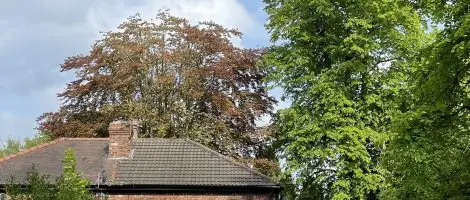
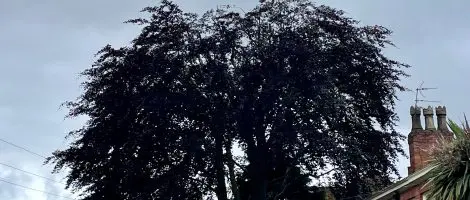
Tree Removal in Preston
Careful tree work in places where judgement matters
Not every tree can – or should – be retained. When removal is the right option, the work needs to be planned properly and carried out with control.
Most tree removals in built-up areas aren’t simply “cut down”. They’re dismantled section by section, often over roofs, gardens, driveways and neighbouring properties, where each piece needs to be managed safely.
We carry out careful tree removal across Preston and the surrounding areas, including large or difficult trees in confined spaces, close to buildings, or in sensitive locations where access and precision matter.

Sectional dismantling close to neighbouring property
When space is restricted, trees are often dismantled piece by piece. Each section is managed carefully to maintain control and reduce the risk of damage to nearby buildings, gardens and other surrounding features.
When tree removal is the right option
Tree removal isn’t always the right first option. Where a tree can be retained safely, it’s usually the better long-term option.
However, removal may be necessary where a tree is dead, structurally unsound, or declining beyond recovery. In other cases, trees may have outgrown their position – affecting nearby buildings, blocking light, or placing pressure on surrounding structures and surfaces.
In built-up areas, even a healthy tree can become unsuitable for its setting. Limited space, proximity to neighbouring properties, or restricted access can all make ongoing management difficult or impractical.
Where removal is the right decision, the focus shifts to how the work is carried out – safely, carefully, and with full consideration for everything around it.
How we carry out tree removal
Tree removal in built-up areas is rarely straightforward. Each job is planned around the specific tree, the space available, and what needs to be protected.
Most work is carried out by dismantling the tree in sections. Branches and timber are lowered carefully using rigging systems where needed, rather than dropped freely – allowing the work to be controlled even in tight or sensitive spaces.
Where access allows, larger sections may be removed using a crane. This can reduce time on site and limit disruption, particularly on larger or more complex removals.
Before any work begins, we consider access, drop zones, neighbouring properties and the condition of the tree itself. The aim is always the same – to carry out the work safely, efficiently, and with as little impact as possible on the surrounding area.

Controlled lowering of large sections using rigging systems.
Where space is limited, sections can be lowered individually using ropes and rigging equipment rather than removed in a single operation.
This allows the work to be carried out safely efficiently while reducing the risk of damage to nearby buildings, gardens and other surrounding features.
How tree removal is planned
Tree removal in built-up areas is planned around the specific tree and its surroundings, rather than approached in a standard way.
In open spaces, work can often be carried out more directly. In residential settings, however, trees are usually dismantled in sections — with each piece lowered carefully to avoid damage to buildings, gardens, and neighbouring property.
Access also plays a significant part. Limited space, restricted entry points, and proximity to surrounding structures all influence how the work is carried out and the time involved.
The condition and structure of the tree itself are equally important. A healthy, well-balanced tree can often be managed more predictably, while trees that are compromised, decaying or structurally weak require a more cautious and controlled approach.
Each job is assessed individually, with the aim of carrying out the work properly, with no unnecessary risk and no shortcuts.

Aerial view of a sectional dismantling operation in a confined residential setting
Trees in built-up areas are often dismantled in sections rather than felled in one piece. Access, neighbouring properties and available drop zones all influence the approach.
View our most recent tree surgery case studies
-

Mature Sycamore Removal
View Case Study: Mature Sycamore Removal -
Tree Pruning at The Beeches Apartments, Bowdon
View Case Study: Tree Pruning at The Beeches Apartments, Bowdon -
Pollarding a Mature Sycamore
View Case Study: Pollarding a Mature Sycamore -
Careful Reduction of a Mature Copper Beech
View Case Study: Careful Reduction of a Mature Copper Beech -
Two Mature Lombardy Poplars Reduced to 6 Metres
View Case Study: Two Mature Lombardy Poplars Reduced to 6 Metres -
Emergency Crane Removal of Fallen Poplar Tree from Apartments
View Case Study: Emergency Crane Removal of Fallen Poplar Tree from Apartments -
Mature Oak Deadwood Removal Over Neighbouring Property
View Case Study: Mature Oak Deadwood Removal Over Neighbouring Property -
Mature Copper Beech Crown Reduction
View Case Study: Mature Copper Beech Crown Reduction